Understanding Pool Luck and Why a Dry Streak Is Not a Bug
Pool luck is the difference between the blocks a pool should find statistically and the blocks it actually finds, and over a short window that difference is normal rather than a fault. At the network difficulty recorded on 21 September 2026 (132.76 T), a 100 TH/s machine is expected to produce roughly 0.0000449 BTC a day, but no single day is obliged to deliver exactly that figure. Whether a dry streak costs you money depends on the payment method you chose, because PPS+ and PPLNS put the luck risk in different hands.[1]
Key takeaways
- A single 100 TH/s unit is about 0.0000001 of network hashrate, so short-window output is noise; what repeats is the average of 0.0000449 BTC per day at today's difficulty.
- PPS+ pays every valid share at current difficulty with hourly settlement, so a dry streak lands on the pool's balance sheet, not on your hourly credit.
- PPLNS pays after a block reaches 6 confirmations, measured across the last 5 difficulty rounds: a quiet window reduces credit even when your machines never stopped.
- Fixed costs do not pause: a 10 PH/s farm on 20 J/TH hardware draws about 200 kW and roughly $288 of electricity per day at $0.06/kWh, against about $380 of gross income.
Why the numbers move
Bitcoin targets one block every ten minutes across the whole network, and finding a block is a random draw among hashes. That is the whole mechanism behind pool luck. A pool does not find the same number of blocks each hour any more than a coin lands heads exactly half the time in every set of ten throws.
Your expected earnings do not depend on luck at all. They depend on one ratio: your hashrate divided by network hashrate, multiplied by the BTC the network issues per day, minus the fee that applies to the component being paid.
With 144 blocks a day and a 3.125 BTC subsidy, the network issues 450 BTC every day, worth about $38,111,400 at BTC/USD 84,692. That figure is the pie. Nothing a pool does changes its size, and a dry streak does not shrink it — it only changes when slices are handed out.
What makes a dry streak feel alarming is the display. Miners watch a live hashrate line and a daily payout number, both of which wobble for reasons that have nothing to do with a fault. A worker that reconnects after a firmware reboot, a rejected share burst, a pool node in a different region answering a fraction slower: each produces a visible dent. None of them means the pool is broken.
What pool luck actually looks like
Luck is usually discussed in difficulty rounds. A round ends when a block is found, and its length varies by design. PPLNS deliberately measures over a longer window than one round, which is why the payout method matters so much when a quiet stretch arrives.
| Question | PPS+ (default) | PPLNS |
|---|---|---|
| Which component carries the 4% listed fee | The PPS-settled block reward | Not applicable |
| Which component carries the 2% listed fee | The transaction-fee component, distributed with PPLNS logic | Block reward and transaction fees together |
| Who absorbs a dry streak | The pool | The miner |
| Settlement trigger | Every hour, at current difficulty | After 6 confirmations, weighted over the last 5 difficulty rounds |
| Expected daily output at 100 TH/s | 0.0000449 BTC (about $3.80 gross) | Same average, wider spread between periods |
| Expected daily output at 1 PH/s | 0.000449 BTC (about $37.99 gross) | Same average, wider spread between periods |
What changes your payout
Four things move a payout, and only one of them is luck.
- Network difficulty. Sharer's share of the network: when difficulty rises, the same hardware earns less BTC for identical work. The 132.76 T reading above is a snapshot, not a constant.
- Coin price. The BTC earned per day changes slowly; its dollar value can move in hours. BTC/USD 84,692 is a reading, not a forecast.
- Uptime and latency. Shares only count when your machines submit them, and a distant node adds reject latency that shows up as missing shares rather than as an error message.
- The fee's attachment point. A listed 4% on the block-reward component and a listed 2% on the transaction-fee component are different sums of money than a flat 4% on everything.[2]
This is where a live view helps more than a monthly statement. On the ViaBTC BTC Mining Pool statistics screen you can compare pool hashrate, network hashrate and difficulty side by side with your own worker output, which separates the three cases that miners otherwise confuse: my machines dropped, the pool had a quiet hour, or the whole network got harder.
Two minutes with the income calculator usually settles the rest, because it converts a coin price, a difficulty figure, a fee rate and a valid hashrate into a daily estimate before you change a single setting. The same inputs feed the mining statistics view, so the numbers you plan with and the numbers you monitor against come from one source.
Worked example: 0.01 BTC at four hashrates
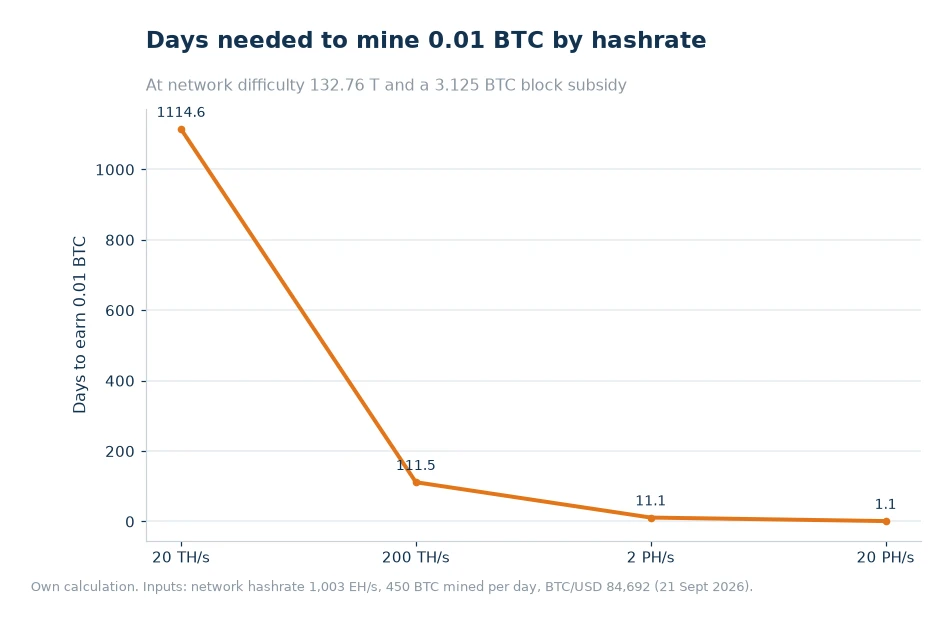
Take a round target of 0.01 BTC and four different rigs, using the network figures above. At 20 TH/s, the daily output is 0.00000897 BTC, so 0.01 BTC takes about 1,115 days. At 200 TH/s it takes about 111 days. At 2 PH/s, about 11 days. At 20 PH/s, roughly 1.1 days.
Now put a dry streak next to that table. If a miner on PPLNS spends three days inside a quiet window where the pool finds fewer blocks than its hashrate implies, the machine hashing 2 PH/s earns close to nothing for those days while the same machine on PPS+ keeps receiving hourly credits sized from its share count. The expected value over a year converges; the cash-flow chart looks nothing alike.
The cost side is what turns a dry streak into a real event rather than a curiosity. A 10 PH/s farm built on 20 J/TH machines draws about 200 kW, which is 4,800 kWh a day and roughly $288 at $0.06/kWh, against about $380 of gross daily income at current difficulty. Electricity is billed every day whether or not the pool's luck cooperates, and that asymmetry — not the size of the fee — is what pushes miners toward a method that pays on schedule.
Worked example: choosing the method that fits the streak you can survive
PPS+ suits fixed bills
Hourly settlement at current difficulty means the credit arrives on a schedule you can put in a spreadsheet next to the power invoice. The trade is a listed 4% on the PPS-settled block-reward component, because the pool is carrying pool-luck and orphan risk on your behalf. For a farm with a loan, hosted rack fees or a strict electricity contract, that is often cheaper in practice than a lower headline rate with lumpy income.[3]
PPLNS suits operators with reserves
The merged block-reward-plus-fee stream is distributed over the last 5 difficulty rounds with a listed 2% fee, so the long-run average is typically higher and the short-run spread is wider. Operators who keep a cash buffer and are not reconciling against a monthly invoice usually prefer it, provided they never read a quiet week as a hardware problem.
What to check monthly
- Your own hashrate versus the pool's. If both dipped, it was the network or the pool. If only yours did, it is a machine, a cable or a firmware setting.
- Credits against the theoretical figure. Multiply your hashrate by 450 BTC and divide by 1,003 EH/s, then compare with what arrived. A gap of a few percent is noise; a persistent 20% gap is a worker that is offline part of every day.
- The difficulty trend, not the difficulty. The next adjustment was estimated at about -2.12% at the time of writing, and small moves in either direction are routine.
- Fee components separately. Check the block-reward line and the transaction-fee line independently, because a single blended percentage hides which one moved.
- Payout thresholds and rail. Zero-fee mining payouts mean the only remaining question is how much sits unsettled between settlement and withdrawal.
Frequently asked questions
What happens if my miner goes offline?
Shares stop, so expected income stops with them. Alerts and a dashboard that shows per-worker hashrate shorten the gap between a failure and a fix.
Is a bigger pool always better?
Size reduces payout variance but also concentrates hashrate. What matters more is fee structure, uptime, latency and payout cadence.
How long can a normal dry streak last?
Longer than most miners expect, because block arrivals are random. On PPS+ the length of a streak changes the pool's result rather than your credit; on PPLNS it changes what a 5-round window pays out.
Should I switch methods during a quiet period?
Switching changes who carries variance and which listed fee applies; it does not change your share of network hashrate. Decide from your fixed costs and cash buffer, not from the last seven days of luck.
The habit that ends the panic
Record your hashrate, the network difficulty and the credits you received once a month, and compare them against the 450 BTC-per-day arithmetic. A dry streak then becomes a data point rather than an emergency: either the three numbers explain the payout, or they show a specific worker whose uptime needs fixing. Keep the fee's two components separate in that ledger, and you will catch the change that actually costs money — a machine sitting idle through a difficulty adjustment — long before it shows up in an invoice.
Data and sources: listed payout methods and fee components are published on the ViaBTC pricing page[1]; network difficulty (132.76 T), network hashrate (about 1,003 EH/s), the 3.125 BTC block subsidy and the BTC/USD price of 84,692 were read on 21 September 2026; the split between the block-reward and transaction-fee components is explained in the fee-breakdown article[2], and mining setup steps are in the support guide[3]. All earning figures are own calculations from those inputs and change as difficulty and price move.